
PRP Hair Loss Treatment Guide – Boston, MA
Empowering Confidence Through Compassion, Expertise, and Care Since 1983

Natural, Non-Surgical Hair Restoration for Women and Men in Greater Boston
The emotional toll of hair loss, whether it appears as a receding hairline, overall thinning, or a widening part, can be profound. For decades, solutions were limited to topical creams, daily pills, or invasive surgery. Today, advances in regenerative medicine offer a clinically supported, natural, and non-surgical alternative: Platelet-Rich Plasma (PRP) therapy.
At PK Walsh in Norwood, we specialize in harnessing the body’s own healing mechanisms to target hair loss at the cellular level. PRP is an evidence-based treatment that uses concentrated components from your own blood to stimulate dormant follicles and support healthier hair growth over time. This guide covers the science behind PRP, who it helps most, what the treatment process involves, and what results are realistic — so you can make an informed decision about whether it is right for you.
If you are ready to compare PRP against other hair restoration options available in the Boston area, or to understand how PRP differs for men versus women, see our complete Boston PRP hair restoration guide.
The Science: How Platelets Rejuvenate Hair Follicles
PRP is not a synthetic drug or a topical serum. It is a bio-active preparation derived directly from your own blood. To understand how it works, it helps to understand the role of platelets beyond their well-known clotting function.
Platelets contain alpha granules that release a concentrated cocktail of growth factors and proteins critical for tissue repair and regeneration. When isolated and applied to the scalp in concentrated form, these growth factors act as a powerful stimulus for weakened hair follicles.
The Role of Key Growth Factors
When injected into areas of thinning, the concentrated platelets release growth factors that perform specific, documented functions in the scalp environment:
- Vascular Endothelial Growth Factor (VEGF): Promotes the formation of new blood vessels around the hair follicle through a process called angiogenesis, increasing the supply of oxygen and essential nutrients to the follicular environment. Clinical research supports VEGF’s role in extending the active hair growth phase in androgenetic alopecia patients.
- Platelet-Derived Growth Factor (PDGF): Stimulates cell proliferation and plays a direct role in follicular development and the maintenance of dermal papilla cells, the cells responsible for regulating the hair growth cycle.
- Insulin-Like Growth Factor (IGF): Supports the survival and activity of hair follicle cells, promotes the anagen (growth) phase, and has been shown in systematic reviews of PRP efficacy to play a meaningful role in outcomes for both male and female pattern hair loss.
- Epidermal Growth Factor (EGF): Accelerates cell growth and differentiation in the skin and follicle, contributing to stronger, thicker individual hair strands over time.
The primary mechanism of action is extending the anagen phase, the active growth phase of the hair cycle, while reducing the time hair spends in the telogen (resting) phase. By counteracting the premature miniaturization caused by genetic and hormonal factors, PRP supports existing follicles in producing thicker, stronger, denser hair. As documented in clinical studies on hair follicle regeneration, PRP does not create new follicles. It restores the productive capacity of follicles that are present but weakened.
Who Is the Ideal Candidate for PRP Hair Loss Treatment?
PRP therapy is effective for both men and women, but its success depends heavily on correct candidacy assessment. Clinical studies report success rates of 70% to 84% for patients with the appropriate type and stage of hair loss. Identifying whether you fall within that group is the essential first step, and it is why a thorough consultation and scalp evaluation matters more than any amount of general information.
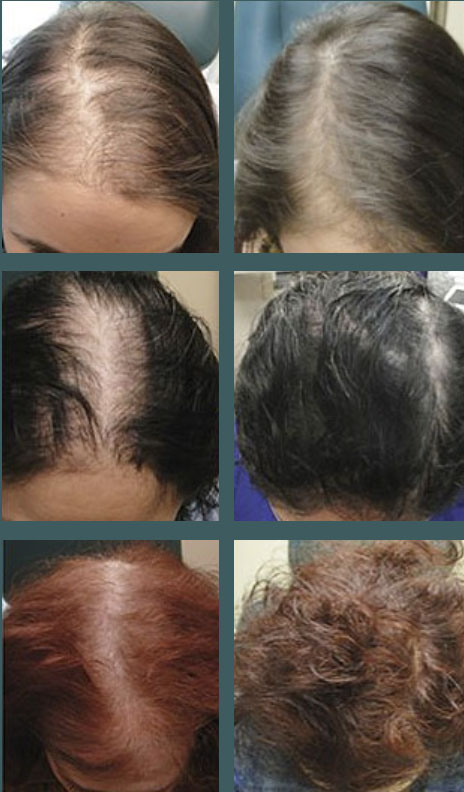 The ideal candidate is a woman or man experiencing:
- Early to moderate hair thinning. PRP works best when hair follicles are still present but have begun to miniaturize, producing progressively thinner, weaker strands. It cannot regenerate follicles that have been inactive for many years or restore hair to areas that are completely and permanently bald.
- Androgenetic alopecia (pattern hair loss). This is the most common form of genetic hair loss in both men and women and is where PRP shows the most significant, consistently documented results. Male pattern baldness and female pattern hair loss both involve follicular miniaturization driven by genetic and hormonal factors, the precise mechanism PRP addresses.
- Recent or progressing hair loss. The earlier treatment begins after noticeable thinning, the more follicular activity there is to support. Patients who act early consistently achieve better outcomes than those who wait until loss is advanced.
A full trichological assessment, examining scalp health, hair shaft quality, loss pattern, and contributing conditions, is the most reliable way to determine candidacy. At PK Walsh, every treatment begins with this evaluation. Learn more about our trichological hair loss services and what a complete scalp assessment involves.
Specialized PRP Programs at PK Walsh
Female and male hair loss follow distinct patterns and require tailored injection protocols and treatment planning. At PK Walsh, we have developed specialized programs for each:
For women: Female pattern hair loss typically presents as diffuse thinning across the crown and midscalp rather than defined recession. Our PRP hair loss treatment for women is designed specifically around these patterns, with protocols informed by extensive experience treating female androgenetic alopecia, postpartum hair loss, and hormonally driven thinning.
For men: Male pattern hair loss follows the defined recession and crown thinning of the Norwood Scale. Our PRP hair loss treatment for men maps injection patterns specifically to male pattern loss zones and is calibrated to the typical progression of androgenetic alopecia in men.
The PRP Treatment Process: What Happens During a Session
PRP hair loss treatment is a minimally invasive procedure performed entirely in our private clinical studio in Norwood. The full session typically takes 60 to 90 minutes, requires no surgery or general anesthesia, and involves no meaningful recovery period.
 Step 1: Blood Draw and Collection
Your session begins with a small blood draw from your arm, similar in volume to a routine lab test, performed by Breanna Connors, RN, our Certified PRP Technician. Because the entire treatment uses your own blood (autologous), there is virtually no risk of allergic reaction, rejection, or communicable disease transmission.
Step 2: Centrifugation and Concentration
The blood sample is immediately placed into a specialized centrifuge that spins at high speed, separating its components by density. This process isolates and concentrates the platelet-rich plasma from the platelet-poor plasma and red blood cells. Our specialized system produces a final preparation containing 5 to 10 times the normal platelet count — the therapeutic concentration range supported by clinical research as optimal for follicular stimulation.
Step 3: Precision Targeted Injection
Before injection, a topical numbing cream is applied to the treatment areas to ensure comfort throughout the procedure. Using an ultra-fine needle, the concentrated PRP is then carefully injected across the areas of thinning or loss — for women, typically the crown and midscalp; for men, the hairline, temples, and crown. This precision targeting delivers the growth factors directly to the dermal layer where hair follicles reside. The injection portion of the session typically takes 30 to 45 minutes.
Setting Expectations: When Will I See Results?
PRP produces natural-looking results because it uses your body’s own biology rather than synthetic compounds. However, hair growth is a slow biological process and results develop gradually over months, not weeks. Understanding the realistic timeline is important for setting appropriate expectations before beginning treatment.
The Realistic Timeline
- Weeks 3 to 6 (Initial Phase): The first noticeable change is typically a significant reduction in hair shedding and breakage. This reflects the early stabilizing effect of PRP on weakened follicles.
- Months 3 to 6 (Visible Regrowth): Visible signs of new growth and increased thickness begin to appear. Patients report that hair feels denser and individual strands feel stronger. Clinical studies document an average increase in hair density of 30% to 40% during this phase for appropriate candidates.
- Months 9 to 12 (Optimal Results): Maximum cosmetic results — including peak density, improved volume, and enhanced hair quality — are typically achieved around 9 to 12 months following completion of the initial treatment series.
Treatment Protocol for Long-Term Success
An initial series of three treatment sessions, spaced approximately four to six weeks apart, is the standard starting protocol. This initial series is designed to build sufficient growth factor concentration in the scalp to produce meaningful follicular response.
Following the initial series, a single maintenance session every six to twelve months is typically recommended to sustain results and continue counteracting the underlying genetic and hormonal drivers of hair loss. Patients who skip maintenance often notice gradual reversal of their gains over time.
Downtime and Aftercare
PRP is non-surgical and involves minimal to no downtime. Most patients return to work and normal daily activities the same day. We recommend avoiding strenuous physical activity, direct sun exposure, and hair products on the day of treatment. Detailed aftercare instructions are provided after each session to help maximize your results.
PRP Hair Loss Treatment in the Greater Boston Area
PK Walsh is located at 315 Norwood Park South in Norwood, Massachusetts, approximately 15 miles south of Boston, with convenient access via Route 1, I-95, and the MBTA Commuter Rail. Most patients from the Greater Boston area find the drive or commute takes approximately 20 to 30 minutes.
We provide PRP hair loss treatment for men and women from throughout the region, including Boston, Cambridge, Newton, Quincy, Wellesley, Brookline, and Providence, RI. Our private studio is designed for discretion — an important consideration for both men and women who prefer to address hair loss in a clinical, professional environment.
With over 40 years of experience in hair restoration and a team that includes a certified trichologist and a Registered Nurse with specialized PRP training, PK Walsh brings a depth of clinical expertise to every consultation and treatment that generalist providers cannot match.








Is PRP Right for You?
Choosing the right hair restoration approach is a decision that deserves more than a general guide. It deserves an honest, thorough evaluation of your specific hair loss pattern, stage, and goals. PRP is highly effective for the right candidates and genuinely inappropriate for others. Knowing which category you fall into before committing to treatment is worth the time it takes to find out.
At PK Walsh, every patient begins with a private consultation that includes a complete scalp and hair evaluation, a candid conversation about what PRP can and cannot realistically achieve in your situation, and a personalized recommendation. If PRP is not the right fit, we will tell you, and we will discuss what alternatives may be more appropriate.
If you are a woman in the Greater Boston area, learn more about our specialized PRP hair loss treatment for women and schedule your private consultation.
If you are a man considering PRP for early to moderate hair loss, visit our PRP hair loss treatment for men page to learn more and request a consultation.